The Ultimate
Kenyan Sand Boa
Care Guide
Engineered for life beneath the surface. This Kenyan Sand Boa care guide explores the biological nuances of Eryx colubrinus, from their unique ambush hunting tactics to the specific requirements of a high-performance Kenyan Sand Boa habitat setup.
Kenyan Sand Boa Care Guide: Evolution
Hailing from the arid scrublands of East Africa, the Kenyan Sand Boa is a marvel of evolutionary specialization. Unlike their arboreal cousins who hunt in the canopy, these snakes have abandoned the vertical world for a life spent almost entirely submerged in loose soil or sand.
Their morphology is built for "The Squeeze." They feature a heavily reinforced, shovel-shaped snout for effortless burrowing and eyes positioned on the very top of their skull—allowing them to remain 99% hidden while surveying the surface for vibration and movement. This "low-profile" lifestyle makes Kenyan Sand Boa care guide uniquely focused on substrate physics.
Vital Statistics
Common Name: Kenyan Sand Boa (KSB)
Lifespan: 20–30 Years
Activity: Nocturnal / Fossorial
Basking Temp: 32°C - 35°C (90°F - 95°F)
Adult Size: 15" (Males) to 30" (Females)
Kenyan Sand Boa Habitat Setup: Volumetric Security
A high-fidelity Kenyan Sand Boa habitat setup is defined by floor space and substrate depth rather than height. Because these snakes are fossorial, they experience chronic stress in enclosures with shallow bedding. Your goal is "Volumetric Security"—a thick layer of loose substrate that allows the boa to thermoregulate by moving vertically through the earth.
Substrate Depth
Provide 4-6 inches of loose substrate. Aspen shavings or a 70/30 play sand/soil mix allow the boa to create stable tunnels. If the snake can touch the bottom glass and the surface simultaneously, the layer is too thin for metabolic safety.
Surface Anchor Points
Even though they burrow, surface decor like flat cork bark or slate rocks provides "low-profile" security. These items act as thermal anchors, holding heat from above to create secondary basking spots on the surface.
Arid Ventilation
Unlike tropical species, Sand Boas require high-exchange ventilation. Cross-ventilation ensures the air remains dry (30-40% humidity). Stagnant air is the leading cause of scale rot and respiratory distress in fossorial snakes.
For an adult female, BundleBiome recommends a minimum footprint of 24x18x12" (60x45x30cm). While they do not climb, the horizontal space is vital for creating a distinct thermal gradient: a hot end (35°C) and a cool end (24°C), allowing the snake to manage its own metabolism.
Kenyan Sand Boa Care Guide: Feeding & Nutrition
Nutrition in Kenyan Sand Boa care guide is straightforward but requires patience. As ambush predators, they prefer to strike from beneath the substrate. Over-handling during feeding times or moving them to a "feeding bin" can trigger stress-induced fasting.
The Precision Feeding Rule: Offer one appropriately sized rodent (no wider than the thickest part of the snake) every 7–10 days for juveniles, and every 10–14 days for adults. Use feeding tongs to wiggle the prey near the substrate surface to trigger their natural "sand-strike" instinct.
Always remember: Heat is their lifeblood, but it must be belly heat. Use an under-tank heater (UTH) or a deep heat projector controlled by a thermostat. This ensures the substrate stays warm enough for the snake to digest its meal while remaining fully buried.
Maintenance Protocol
Kenyan Sand Boa Care Guide: Health & Bio-Signals
When following this Kenyan Sand Boa care guide, we prioritize metabolic efficiency. These snakes are incredibly hardy, but their sedentary lifestyle means health issues can go unnoticed if the keeper isn't observant.
Regurgitation: Often caused by handling too soon after a meal or incorrect temperatures. If a KSB cannot reach 32°C+ (90°F+), they cannot digest. Always wait 48 hours after feeding before handling.
Stuck Shed: While they prefer an arid environment, Sand Boas need a "humid micro-climate" to shed successfully. Providing a buried humid hide filled with damp moss allows them to hydrate their skin without raising the ambient humidity of the entire enclosure.
The Health Checklist
Kenyan Sand Boa Care: Morph Identification
The Sand Boa hobby has transitioned from the classic orange and black into high-contrast designer morphs. From the stark whites of the Snow to the deep reds of the Rufescens, these snakes are a testament to selective breeding.
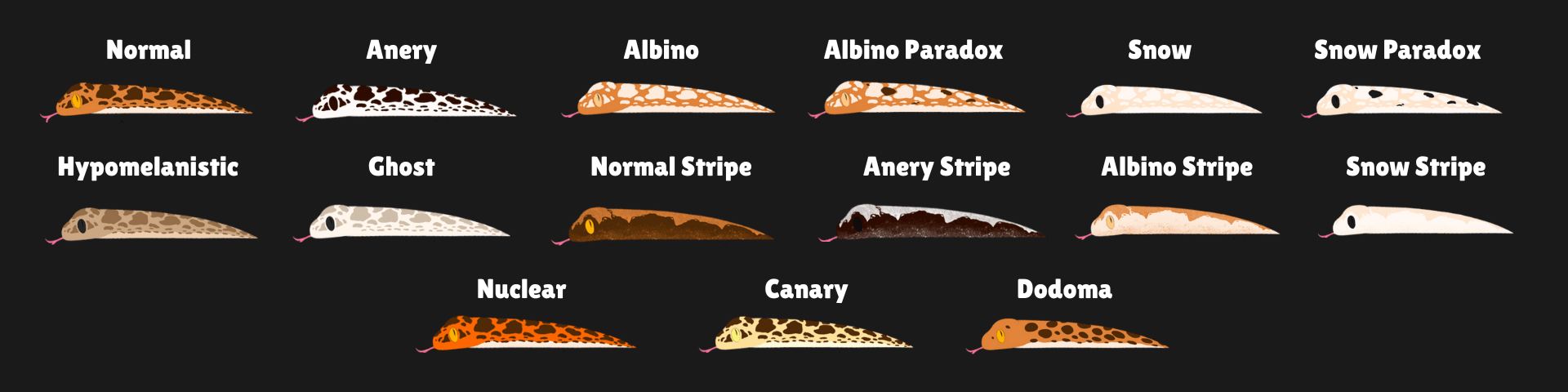
The Subsurface Spectrum
There are roughly 15–20 major recognized Kenyan sand boa morph categories, with hundreds of visual variations within them. With many pattern types, every keeper can find something that suits their taste.
Displaying Morphs
Display dark-base morphs against light aspen shavings and grey slate rock. Display bright morphs against deep-toned soil mixes and dark cork bark anchor points.
Metabolic Change
A boa’s colour intensity can be temporarily muted by metabolic shed cycles, a normal physiological response known as going into blue.
Kenyan Sand Boa Care: Humidity & Temperature
Mastering a Kenyan Sand Boa habitat setup requires understanding "Belly Heat Logic." Because they are fossorial, they don't bask under a sun lamp in the traditional sense; they absorb heat from the earth. Incorrect thermal gradients are the leading cause of digestive failure and regurgitation in this species.
The Hot Spot Zone
Ideal: 32°C - 35°C (90-95°F)
Safety: Use a thermostat probe directly on the glass/floor under the substrate to prevent thermal burns.
The Arid Gradient
Maintain 30-40% humidity. Stagnant, moist air is toxic to Sand Boas, but a localized humid hide must be provided during shed cycles.
Substrate Insulation
Deep substrate (4"+) creates a natural insulator. The snake will dive deeper to cool down or sit near the heat source to accelerate metabolism.
The High-Fidelity Kenayan Sand Boa Habitat Advantage
While bioactive arid setups are popular, they present a major risk for Sand Boas: Substrate Saturation. Living plants require water that can spike humidity levels beyond the safety zone for Eryx colubrinus. High-quality artificial decor provides the same realistic aesthetic without the risk of respiratory infection.
Professional-grade artificial stones and lightweight cork capture the visual depth of the East African scrubland. Unlike heavy natural rocks, these curated pieces won't crush a burrowing snake if they shift, and they can be fully sanitized in minutes, ensuring a sterile and safe environment.
Why High-Fidelity?
Crush Safety: Lightweight materials protect burrowers.
Zero Mold: Keeps dry substrate sterile.
Bio-Security: 100% washable and parasite-free.
Visual Impact: Stays desert-crisp forever.
The BundleBiome Solution
Designing a naturalistic arid habitat shouldn't be a guessing game. At BundleBiome.ca, our Kenyan Sand Boa care guide philosophy focuses on curation over manufacturing. We hand-select the most realistic, snake-safe pieces from the world's leading herpetology brands—including Zoo Med, Pangea, ReptiZoo, etc... and organize them into a scientifically balanced Kenyan Sand Boa habitat setup.
Our bundles eliminate the risk of choosing the wrong materials. We ensure every component is lightweight, heat-safe, and visually consistent. By curating the "best of the best" into ready-to-install biomes, we provide a professional-grade habitat that looks like a high-end zoo display, delivered in a single package.
Your Subsurface Biome
Give your Sand Boa the depth it deserves. Our Arid Biome Bundles provide the perfect foundation for a healthy, hidden, and happy reptile. One box, one setup, zero guesswork.
See All Biomes

