The Ultimate
Red-footed Tortoise
Care Guide
The Red-footed Tortoise is a flagship species of South American biodiversity. This comprehensive guide covers the intricate biological demands of the Chelonoidis carbonarius, from the humid canopy-filtered light of the Amazon to the technical precision of a professional Red-footed Tortoise habitat setup.
Red-footed Tortoise Care Guide: Evolution & Origin
Native to the tropical rainforests and savannas of Central and South America, the Red-footed Tortoise is a testament to forest-floor adaptation. Unlike arid-dwelling species, these tortoises spend their lives under the dense canopy, where humidity remains high and the sun is dappled.
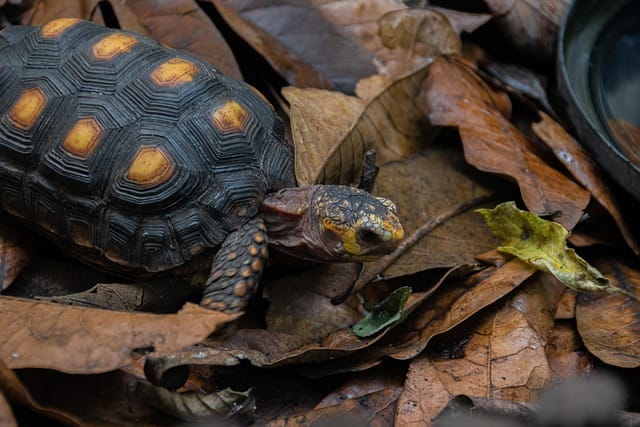
They are characterized by their dark carapace and brilliant red-to-orange scales on their limbs and head. Evolution has made them omnivorous scavengers; they actively forage for fallen fruits, greens, and even occasional animal protein. This unique metabolism makes humidity and dietary variety the two most critical pillars in your Red-footed Tortoise care strategy.
Vital Statistics
Common Name: Red-footed Tortoise
Lifespan: 30–50+ Years with proper care
Activity: Diurnal (Day Active)
Thermal Range: 24°C - 32°C
Red-footed Tortoise Habitat Setup: Structural Needs
A professional Red-footed Tortoise habitat setup is an exercise in floor-space optimization and humidity buffering. Unlike desert species, these tortoises require a "Micro-Climate" strategy. Your goal is "Forest Floor Logic"—a system of deep, damp substrate and low-level visual barriers that allow the tortoise to feel secure while exploring.
Footprint Scale
Adults require significant space. A minimum of 6ft x 3ft is recommended. For indoor setups, specialized PVC tortoise tables are superior for holding the 80% humidity required.
Substrate Depth
Depth is the key to hydration. A 4–6 inch layer of Coco Coir or Cypress Mulch allows the tortoise to burrow slightly, accessing the damp lower layers to prevent shell drying.
Visual Barriers
Tortoises are highly active foragers. Using logs and artificial plants to break up their line of sight encourages exercise and reduces stress by making the enclosure feel larger.
For an adult, BundleBiome recommends a Closed-Chamber approach for indoor keeping. This orientation provides total control over the tropical cycle, ensuring the air remains humid enough to prevent "pyramiding" (abnormal shell growth) throughout the animal's 50-year life.
Red-footed Tortoise Care: The Metabolic Rhythm
Nutrition in Red-footed Tortoise care is about diversity. These tortoises have a unique metabolism that requires more than just grasses. They are one of the few tortoise species that actively seek out fallen fruit and even carrion in the wild.
We advocate for the 70-20-10 Rule: 70% dark leafy greens (collards, hibiscus, clover), 20% tropical fruits (papaya, mango), and 10% animal protein (low-fat mazuri or earthworms) offered bi-weekly. This protein is essential for their long-term organ health and shell integrity.
Always remember: Hydration is internal. While they drink from bowls, they absorb significant moisture through their skin and by breathing humid air. If the air is dry, the tortoise is dehydrating, even if a water bowl is present.
Maintenance Protocol
Red-footed Tortoise Care Guide: Health & Bio-Signals
Red-footed Tortoises are resilient, but they are highly susceptible to environmental neglect. In a professional Red-footed Tortoise care guide, we prioritize shell and respiratory integrity.
The Pyramiding Factor: Pyramiding (the upward growth of shell scutes) is not caused by too much protein, but by too little humidity during the first 5 years of life. It is a sign of a failed habitat setup. Once it happens, it cannot be reversed, only halted with corrected husbandry.
Clear Airways: These tortoises are prone to Respiratory Infections (RI) if kept too cold and wet simultaneously. Temperatures should never drop below 22°C (72°F) if the humidity is high. If you see "bubbles" at the nose, an immediate temperature increase is required.
The Health Checklist
Red-footed Tortoise: Rare "Morphs"
The hobby focuses on distinct "Morphs," each offering unique visual traits.
Known for their calm, curious nature and gentle, steady movements. these tortoises are the gems of the forest floor.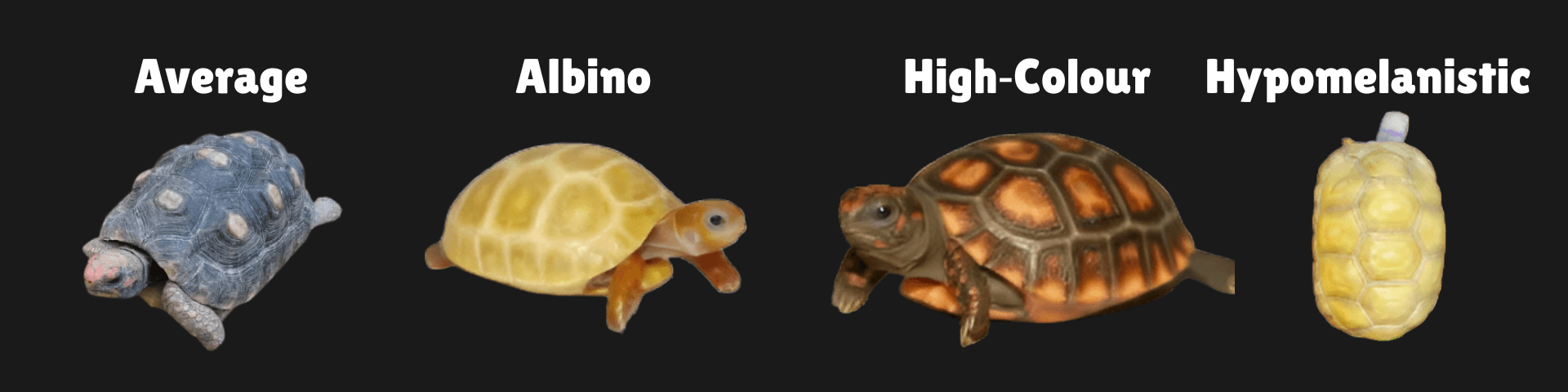
Rare Morphs
True morphs like Hypo and Albino are extremely new and uncommon. They change appearance and in some cases care.
Genetic Variation
Red‑footed tortoises show natural and captive‑bred variation in color and pattern. Most differences are visual only.
Locale Diversity
Red‑footed tortoises originate from multiple regions across South America. There are 4–5 commonly recognized Red‑footed Tortoise locales.
Red-footed Tortoise Care Guide: Humidity & Temperature
Mastering a Red-footed Tortoise habitat setup requires precision in the "Humidity Gradient." Unlike desert tortoises, Red-foots cannot survive in dry heat. We recommend a constant humidity level of 70-80% with accessible "Micro-Climates" (humid hides).
The Thermal Gradient
Basking: 31°C - 33°C (88-92°F)
Ambient: 27°C - 29°C (80-84°F)
Night Drop: 22°C - 24°C (72-75°F). Never allow a tropical tortoise to drop below 20°C.
Hydration Mechanics
Implement morning misting to simulate forest dew. Use a cool-mist fogger on a timer to maintain a "humid floor layer" where the tortoise breathes, preventing lung irritation.
The Deep Hydration Well
The secret to perfect shells is not spraying the tortoise, but hydrating the substrate from the bottom up. This creates a rising vapor that keeps the plastron and carapace healthy.
The High-Fidelity Red-footed Tortoise Advantage
Bioactive setups for Red-foots are a challenge because these tortoises are "bulldozers" that will trample and consume most live tropical plants within weeks. High-quality artificial plants and decor provide the necessary cover and shade without the risk of plant death or pesticides.
Professional-grade artificial foliage provides the "Visual Security" tortoises crave. Large tropical leaves act as umbrellas for your misting system, creating the dripping water effects found in the Amazon. Our decor is 100% washable, allowing for a hygienic biome that can withstand the heavy traffic of a 10lb tortoise.
Why High-Fidelity?
Tortoise Proof: Rugged enough for bulldozing behavior.
Safe Enrichment: Non-toxic materials that won't be eaten.
Hygiene: Easy to deep-clean and sanitize.
Stability: Won't wilt in high-heat basking zones.
The BundleBiome Solution
Designing a tropical tortoise habitat shouldn't be a guessing game. At BundleBiome.ca, we curate the world's most durable, tortoise-safe decor to build scientifically balanced tropical biome kits.
Our Tropical Bundles provide the dense cover and moisture-retaining surfaces your Red-footed Tortoise deserves. We eliminate the risk of choosing fragile plants, ensuring every piece provides the shade and security they need to thrive for decades in your home.
Your Tropical Sanctuary
Expert care starts with expert infrastructure. Our Tropical Biome Bundles provide the security, moisture retention, and shade your tortoise deserves.
See All Guides

